Just to let you know that all my blogs have been "moved" into one account. I had them set to particular email accounts that would differentiate each accordingly but for efficiency I transferred all four blogs to the one main account so you might see some of my profile stats different, i.e. now under isshin.do.karate@gmail.com mail account, etc.
Everything else remains intact as do the actual historical postings, etc.
Thanks,
Charles J.


The "EYES" Must See
Note: I felt that this was also related to my recent posts on this blog.
I can be stubborn where once I learn something that really resonates with me with emphasis on my practice of karate-do I tend to resist any attempts to refute that premise even when it is incontrovertible truth. I have since found that this is a crippling trait that I now try to avoid at all costs. It assumes that my findings are the final answer when in reality all answers are subject to "change."
In this light the ken-po goku-i's reference in line seven also can mean to "see" truth; to "see" beyond our limited understanding of things; to "see" that all idea's and answers to all things are subject to the same laws that govern the Universe, i.e. constantly changing; fluid. We must "see" ourselves for what we truly are so that we don't color our view with preconceived notions and idea's that we tend to make intractable so we remain inflexible; a path to disaster and stunted growth both personal and in martial training.
Seeing all sides is to "see" all sides. Don't limit your interpretation and application of this to just what you literally see to all sides of your physical presence. Step outside the box, see all sides!
Something New Every Day
It is amazing that I can learn something absolutely new and still see that it was there all along but because I didn't have some frame of reference I failed to see it in that particular light. I say particular light because I feel we all know some of this stuff yet fail to bring it to the forefront of our minds because that reference point fails to surface and point the way.
Today, I see something that I find "critical" to the practice of martial arts, any art. That one thing that seems to provide a connection to all things but tends to fall away because of many factors of which one is simply not seeing it for the shadow we ourselves cast over it.
Let me say that all martial arts are good. They all serve a purpose. The specifics of a system are more in line with creating its unique personality that tends to fit individual personalities. I like Okinawan Isshinryu because the aspects unique to that system speak to me individually. You might practice Kung Fu, one of its many flavors.
So, what are the unifying aspects of all martial arts that connect us all universally? One is basics, the introduction to the system. This does not change. The next are the fundamentals of martial systems, they also do not change. Lastly, for now anyway, are the principles of the martial arts, they also don't change. I can add, for this moment till I study it a bit more, that both principles and fundamentals meet or converge.
I will quote Sensei Steven L. Pearlman from his book, "The Book of Martial Power." In chapter one, "The Nature and Importance of Principles," he gives a definition as follows:
Principle
- A "fundamental" law or truth upon which other techniques and actions are based;
- The natural way a thing [such as the human body] operates; and
- A philosophical or moral tenet.
Note: See bibliography below and get a copy, well worth the cost and effort.
Body mechanics, fundamental that transcends a particular system and encompasses all of them.
Momentum, fundamental that transcends a particular system and encompasses all of them.
Just two samples of what I see as both fundamental and a principle as defined above. As he explains this is the principles that allow all the different and varying systems practiced doable as long as one takes the time to learn the principles/fundamentals that give the system its "oomph!"
So, because I seek knowledge from any and all sources. Because I just happened to read the "Mokuren Dojo Blog." Because Patrick Parker Sensei decided to write posts on this books content I found another library addition that helps be believe and strive to open my mind and allow many new concepts and things, although they were always there, by turning on another light to illuminate the many paths we have available in our pursuit of the way or karate-do for me.
Even in the many factions of Isshinryu, regardless of beliefs and arguments that differentiate them, these truths, principles, remain identical in all factions, tribes, or systems; your choice of naming.
Bibliography:
Perlman, Steven J. "The Book of Martial Power: The Universal Guide to the Combative Arts." New York. The Overlook Press. 2006.
Caveat: I reserve the right to be incorrect on this so expect me to change as I read and go on... ;-)
Today, I see something that I find "critical" to the practice of martial arts, any art. That one thing that seems to provide a connection to all things but tends to fall away because of many factors of which one is simply not seeing it for the shadow we ourselves cast over it.
Let me say that all martial arts are good. They all serve a purpose. The specifics of a system are more in line with creating its unique personality that tends to fit individual personalities. I like Okinawan Isshinryu because the aspects unique to that system speak to me individually. You might practice Kung Fu, one of its many flavors.
So, what are the unifying aspects of all martial arts that connect us all universally? One is basics, the introduction to the system. This does not change. The next are the fundamentals of martial systems, they also do not change. Lastly, for now anyway, are the principles of the martial arts, they also don't change. I can add, for this moment till I study it a bit more, that both principles and fundamentals meet or converge.
I will quote Sensei Steven L. Pearlman from his book, "The Book of Martial Power." In chapter one, "The Nature and Importance of Principles," he gives a definition as follows:
Principle
- A "fundamental" law or truth upon which other techniques and actions are based;
- The natural way a thing [such as the human body] operates; and
- A philosophical or moral tenet.
Note: See bibliography below and get a copy, well worth the cost and effort.
Body mechanics, fundamental that transcends a particular system and encompasses all of them.
Momentum, fundamental that transcends a particular system and encompasses all of them.
Just two samples of what I see as both fundamental and a principle as defined above. As he explains this is the principles that allow all the different and varying systems practiced doable as long as one takes the time to learn the principles/fundamentals that give the system its "oomph!"
So, because I seek knowledge from any and all sources. Because I just happened to read the "Mokuren Dojo Blog." Because Patrick Parker Sensei decided to write posts on this books content I found another library addition that helps be believe and strive to open my mind and allow many new concepts and things, although they were always there, by turning on another light to illuminate the many paths we have available in our pursuit of the way or karate-do for me.
Even in the many factions of Isshinryu, regardless of beliefs and arguments that differentiate them, these truths, principles, remain identical in all factions, tribes, or systems; your choice of naming.
Bibliography:
Perlman, Steven J. "The Book of Martial Power: The Universal Guide to the Combative Arts." New York. The Overlook Press. 2006.
Caveat: I reserve the right to be incorrect on this so expect me to change as I read and go on... ;-)
Details
Something we strive to learn up front then forget about once we can actually do it while retaining the details in the application. Some details are pertinent to the application while others are just distractions. Knowing the difference is an important detail.
CB Radio Era

This is what I think of every time I see someone assume some Japanese sounding term or name to call themselves to form some newly perceived ultimate traditional martial system. I say this with a smile as I am a person who has done some research and experimentation using Japanese, Kanji characters, and so forth in my attempts to understand what is being conveyed from the older practices newly translated. Example is my recent posting on the characters vs. the full English translation of the ken-po goku-i.
In jest I once took a Japanese name for a forklift company I saw on a billboard and used it to promote/test levels of knowledge and understanding, i.e. the name was "Kumatsu forklifts" of which I once used, "Kumatsu," to name some obtuse kata that I am sure was made up by someone who didn't really know anything about karate/karate-do. Funny, people took me seriously.
"10-10 we down we gone bye bye!" CD lingo, movie generated sound bytes, for good bye, signing off now. Sounds cool but means nothing and is an irritant to those who actually use the radio's, back in the late seventies, for business and more serious communications.
I like playing around with kanji and trying to figure out if I can actually put it together right but seriously I prefer in most cases to use English explanations to convey idea's and intent a bit more accurately.
I guess it is part of all the glamour some tend to seek out by taking what they perceive is some exotic form of exercise. Break-break-good buddy, got your ears on? Funny I even remember that CB crap.
Frame of Reference
In order for the mind/brain to do something it has to have some sort of frame of reference. It does not have to be exact but something that will allow the brain to piece together some response for the mind-body to take or not take. Training is supposed to provide a frame of reference for the karate-ka to achieve some proficiency.
Sometimes we find ourselves rejecting something because we don't have or cannot create some reference point that corresponds to what we already know or have learned in other settings, we refuse to allow a reference to achieve its goal because our brain's monkey mind tells us that does not compute even if it does and would work.
Basics, fundamentals, kata, kumite, and so forth are tools that build on our references and if done correctly will not be rigid to one but allow the brain to do what it does best, take the many options and form a action or response that has a frame of reference to that training and if realistic and done well enough overcomes the monkey mind and acts.
In order to understand those experiences most karate-ka have never experienced cannot truly understand fully what that particular experience will effect as to the mind. There are some things that will cause us to freeze or act inappropriately for the event simply because it cannot fathom what is happening and thus no frame of reference nor an ability to break out of the freeze, etc.
It is imperative that training and practice break out of the comfort zone and seek out those chaotic events that can be induced in training much like the military and police, etc. where their training must be such that it programs the mind with reference points that can be enacted until the mind truly achieves some experience in real time.
This is a discussion that has and will go on for a long time for today's martial systems simply due to a lack of understanding and a frame of reference for most that will allow the brain to reach beyond the comfort zone and seek out knowledge and experience, of a sort with out actually getting it live, that will provide the programs, those modules that are pieced together by the main brain program, so that it can provide action instantly.
Does this make sense?
p.s. education + experience is the formula to = frame of reference ...
Sometimes we find ourselves rejecting something because we don't have or cannot create some reference point that corresponds to what we already know or have learned in other settings, we refuse to allow a reference to achieve its goal because our brain's monkey mind tells us that does not compute even if it does and would work.
Basics, fundamentals, kata, kumite, and so forth are tools that build on our references and if done correctly will not be rigid to one but allow the brain to do what it does best, take the many options and form a action or response that has a frame of reference to that training and if realistic and done well enough overcomes the monkey mind and acts.
In order to understand those experiences most karate-ka have never experienced cannot truly understand fully what that particular experience will effect as to the mind. There are some things that will cause us to freeze or act inappropriately for the event simply because it cannot fathom what is happening and thus no frame of reference nor an ability to break out of the freeze, etc.
It is imperative that training and practice break out of the comfort zone and seek out those chaotic events that can be induced in training much like the military and police, etc. where their training must be such that it programs the mind with reference points that can be enacted until the mind truly achieves some experience in real time.
This is a discussion that has and will go on for a long time for today's martial systems simply due to a lack of understanding and a frame of reference for most that will allow the brain to reach beyond the comfort zone and seek out knowledge and experience, of a sort with out actually getting it live, that will provide the programs, those modules that are pieced together by the main brain program, so that it can provide action instantly.
Does this make sense?
p.s. education + experience is the formula to = frame of reference ...
Learning is Never Ending
I am currently reading through the book I found through Mr. Patrick Parker Sensei's blog, "Mokuren Dojo." Search through his blog site for the titles that have "BOMP" in them for his postings.
I remember at my start as a black belt that I knew a lot and I still understood that I had a lot of learn yet till in this "later years" I never fully realized just how important all that hoopla I got as a young person was so relevant, eduction. I sometimes in early years felt that once I learned something specific it was pretty much written in stone. I also fell into that mode of refuting any idea's or comments that went against that belief and understanding almost to the point of ignoring irrefutable proof of my wrong vs. a right or better yet my inaccurate vs a more accurate piece of knowledge.
The book is, "The Book of Martial Power," by Steven J. Perlman Sensei. I like hard covered books so spent the extra as I suspected, rightly so, that is would be a important and permanent library addition. The paperback is only $12.21 on Amazon also well worth the cost.
I am barely 3/4's the way through it and find so much it is mind boggling. I can only say thanks to Mokuren Dojo blog, Parker Sensei, for discussing the topic as I may not have found it otherwise.
It comes down to seeing things from a view that says, "hey, I didn't know that," to "hey, that is why I do that," to "hey, what a great way to explain it," to "I have so darn much to learn still," and many other ways to look at the value of today's materials.
I began seriously in the seventies and must say that as time has passed the quality and value of the material on martial arts has improved regardless of either the sporting aspects or the commercialism. There are those who took the time and energy to rediscover the basics, fundamentals, and principles of martial systems that for our time now can be conveyed in many different forms from the likes of Mokuren Dojo to Perlman Sensei's book to others such as:
Warner Dean Henry, Patrick Parker, John Vesia, Sue Wharton (SueC), Mario McKenna, Rory Miller, Marc MacYoung and his wife's animal list, Arcenio Advincula, Gary Henry, Charles Goodin, Dojo Rat, Rob Redmond, Tris Sutrisno, Lawrence A. Kane, Dave Lowry, Elmar T. Schmeisser, James Legge, Richard Wilhelm, Loren W. Christensen, Nancy Sherman, Gavin DeBecker, George Mattson, Michael Clarke, George Breed, Patrick McCarthy, Nicklaus Suino, Angel Lemus, P.M. Forni, Jill Bolte Taylor, H. E. Davey and so many more in books, blogs, DVD's, VHS, and other media provide insights that a martial artist can learn from and attain more knowledge even if they cannot directly participate in the training and practice of all these fine martial artists.
All I can say is that my current reading material has gone further than my meodicre writing and teaching abilities that it is inspiring. In the commercialized world in which we live it is critical that the few like these folks insist on taking it further and farther than just learning enough, to seek out more, and more, and more is wonderful.
Thanks to everyone, everyday! This gives so much more meaning to the maxim that one who wishes to truly follow the way will never stop learning their entire lives. It is so true for me.
Note: If you see a name you do not recognize then take a look at my library list at the bottom of this blog to find the book in question. As to DVD's and so on, google it!
I remember at my start as a black belt that I knew a lot and I still understood that I had a lot of learn yet till in this "later years" I never fully realized just how important all that hoopla I got as a young person was so relevant, eduction. I sometimes in early years felt that once I learned something specific it was pretty much written in stone. I also fell into that mode of refuting any idea's or comments that went against that belief and understanding almost to the point of ignoring irrefutable proof of my wrong vs. a right or better yet my inaccurate vs a more accurate piece of knowledge.
The book is, "The Book of Martial Power," by Steven J. Perlman Sensei. I like hard covered books so spent the extra as I suspected, rightly so, that is would be a important and permanent library addition. The paperback is only $12.21 on Amazon also well worth the cost.
I am barely 3/4's the way through it and find so much it is mind boggling. I can only say thanks to Mokuren Dojo blog, Parker Sensei, for discussing the topic as I may not have found it otherwise.
It comes down to seeing things from a view that says, "hey, I didn't know that," to "hey, that is why I do that," to "hey, what a great way to explain it," to "I have so darn much to learn still," and many other ways to look at the value of today's materials.
I began seriously in the seventies and must say that as time has passed the quality and value of the material on martial arts has improved regardless of either the sporting aspects or the commercialism. There are those who took the time and energy to rediscover the basics, fundamentals, and principles of martial systems that for our time now can be conveyed in many different forms from the likes of Mokuren Dojo to Perlman Sensei's book to others such as:
Warner Dean Henry, Patrick Parker, John Vesia, Sue Wharton (SueC), Mario McKenna, Rory Miller, Marc MacYoung and his wife's animal list, Arcenio Advincula, Gary Henry, Charles Goodin, Dojo Rat, Rob Redmond, Tris Sutrisno, Lawrence A. Kane, Dave Lowry, Elmar T. Schmeisser, James Legge, Richard Wilhelm, Loren W. Christensen, Nancy Sherman, Gavin DeBecker, George Mattson, Michael Clarke, George Breed, Patrick McCarthy, Nicklaus Suino, Angel Lemus, P.M. Forni, Jill Bolte Taylor, H. E. Davey and so many more in books, blogs, DVD's, VHS, and other media provide insights that a martial artist can learn from and attain more knowledge even if they cannot directly participate in the training and practice of all these fine martial artists.
All I can say is that my current reading material has gone further than my meodicre writing and teaching abilities that it is inspiring. In the commercialized world in which we live it is critical that the few like these folks insist on taking it further and farther than just learning enough, to seek out more, and more, and more is wonderful.
Thanks to everyone, everyday! This gives so much more meaning to the maxim that one who wishes to truly follow the way will never stop learning their entire lives. It is so true for me.
Note: If you see a name you do not recognize then take a look at my library list at the bottom of this blog to find the book in question. As to DVD's and so on, google it!
Kata Particulars
Mentioned this a few times and believe wrote a post on it, kata is not supposed to be static. Yes, in the beginning to build a blueprint one follows the systems basic/fundamentals yet there comes a point when you have to go outside the box, that comfort zone of where you feel you can do it with out thought. A common mistake when discussions of mind-no-mind come up. Being able to perform a kata with out thought is merely dancing. Remaining stuck in the basics of a kata are stifling.
The particulars of a kata are those that provide the brain/mind a means to reference it or its individual parts to construct on the fly an appropriate response be it verbal or physical. The brain does not file whole thoughts and idea's into a memory slot. Those entire memories are fragmented and stored where ever the brain stores them according to the process you use to learn it, i.e. like association which is a bunkai to a stance and technique, so you can begin to understand the repetitive practice need in karate-do.
Kata have stances that vary along with techniques unique to some particular strategy/tactic of combat yet it is not exclusive. If it were, as it is practiced today, then you would learn about every conceivable fighting/combative situation and never be hit BUT it is complex and there are zillions of variances to it so kata in that light would be totally inefficient but if you take the road to beyond the basics/fundamentals of the system, kata, etc. then you can see how the brain works with pieces so if a new event occurs the brain can pieces together a response. The brain is something miraculous.
Kata particulars are not written in stone. Although the fundamentals of the system should remain intact it does NOT mean that it remains intact as you progress but becomes a living thing coupled with realistic training and practice achieves great things; or not.
A good example that has seemingly taken over a kata in practice is the "timing" issue. My perception of timing is different from others. Others tend to look at it as the time it takes to perform the kata where a particular time is provided much like the start/stop point of embusen where a person has to stop at the allotted time for a particular kata. Time over or under is used to reduce scores. This seems sporting but not realistic to effective use of kata for combative purposes.
Timing to me is what is needed to apply effective technique at a particular target point using a particular stance and technique finding the vertical axis target point and meeting it effectively and optimally to not get hit and take out the ability of an attacker to continue doing damage. There is an effective timing, much like in music, and a rhythm that can be applied to ensure it is done according to the fundamentals, i.e. momentum, distance, pose, posture, effective body alignments, etc.
Something to consider, something to think about, something to contemplate; don't you think?
Another issue to me is "rushing." Watch a kata and sometimes you see it as if the person is working extra hard to get it over with. Listen up, the most wonderful part of kata practice and training is finding the rhythm and timing according to the many facets of bunkai interpretations leaving a limiting concept of overall time constraints out of the picture entirely. It is done when it is done. It has a purpose, fluid and changing, so let the life of kata come forth and create itself in real time. It may be why Tatsuo Sensei was known to do kata a bit differently each time, it was a living thing he was connecting to his body and mind.
 A symbiotic relationship development process! After all, many lost effectiveness can be attributed to a rush with basics, fundamentals, and kata training and practice. This could be many, many posts, you think?
The particulars of a kata are those that provide the brain/mind a means to reference it or its individual parts to construct on the fly an appropriate response be it verbal or physical. The brain does not file whole thoughts and idea's into a memory slot. Those entire memories are fragmented and stored where ever the brain stores them according to the process you use to learn it, i.e. like association which is a bunkai to a stance and technique, so you can begin to understand the repetitive practice need in karate-do.
Kata have stances that vary along with techniques unique to some particular strategy/tactic of combat yet it is not exclusive. If it were, as it is practiced today, then you would learn about every conceivable fighting/combative situation and never be hit BUT it is complex and there are zillions of variances to it so kata in that light would be totally inefficient but if you take the road to beyond the basics/fundamentals of the system, kata, etc. then you can see how the brain works with pieces so if a new event occurs the brain can pieces together a response. The brain is something miraculous.
Kata particulars are not written in stone. Although the fundamentals of the system should remain intact it does NOT mean that it remains intact as you progress but becomes a living thing coupled with realistic training and practice achieves great things; or not.
A good example that has seemingly taken over a kata in practice is the "timing" issue. My perception of timing is different from others. Others tend to look at it as the time it takes to perform the kata where a particular time is provided much like the start/stop point of embusen where a person has to stop at the allotted time for a particular kata. Time over or under is used to reduce scores. This seems sporting but not realistic to effective use of kata for combative purposes.
Timing to me is what is needed to apply effective technique at a particular target point using a particular stance and technique finding the vertical axis target point and meeting it effectively and optimally to not get hit and take out the ability of an attacker to continue doing damage. There is an effective timing, much like in music, and a rhythm that can be applied to ensure it is done according to the fundamentals, i.e. momentum, distance, pose, posture, effective body alignments, etc.
Something to consider, something to think about, something to contemplate; don't you think?
Another issue to me is "rushing." Watch a kata and sometimes you see it as if the person is working extra hard to get it over with. Listen up, the most wonderful part of kata practice and training is finding the rhythm and timing according to the many facets of bunkai interpretations leaving a limiting concept of overall time constraints out of the picture entirely. It is done when it is done. It has a purpose, fluid and changing, so let the life of kata come forth and create itself in real time. It may be why Tatsuo Sensei was known to do kata a bit differently each time, it was a living thing he was connecting to his body and mind.

We Want to Feel Special
I have come to the conclusion, for today and this moment anyway, that uniforms, patches, belts, titles, and other stuff in karate is simply our strong desire to be special. We all want to be unique in some way which is funny because in general that leads to trends.
A trend I personally find kind of "interesting [being kind here]" is this fad of wearing really baggy pants down around your hips and below. I watch guys walking around as if they have something caught up their backside, you know a bit like the Charlie Chaplin walk. This trend got started in an underwear ad, i.e. Marky Mark at the time did an ad with no shirt and his pants down enough to display the upper half of white skivvies.
It seems we have no limits because I have even viewed sites that actually have a mock up of a uniform with indications as to where all the patches are to be placed and in one there is almost nowhere on the uniform that does NOT have some patch showing.
Ok, you saying, who the f*&^ are you telling me yadda yadda yadda. I once held that patches and titles were acceptable in my instruction and practice. I had the Isshinryu patch over the heart and then I added one for being in a tournament referee's certification org, the association patch and then another set of patches for the shoulder with some kanji that had some special "warrior quote." I been there, done that and now realize just how stupid I was going there as it did not do anything but get a few laughs from folks I respected.
I also feel that our need to stand out and feel special carries forth to our "great need" for external validation from guys who we think are the end all experts and authorities on the art of karate and other martial systems. In reality I discovered those who were really, really experts and authorities on their respective systems didn't go with this stuff.
Yes, again I went this way as well so I speak from "personal" experience. I joined two different Isshinryu orgs in those early years, i.e. early 1980's, only to discover that if I looked beyond the fluff it became political/control with a lot of money driving it forward. I came to know that if I did not spend my money to attend sanctioned seminars or buy their karate/martial gear/uniforms, etc. or I didn't participate in their sanctioned events, i.e. tournaments, etc. I could not qualify for any promotions and then only if I paid the fee. Let me tell you, even then, the fees were pretty big when you consider your paying it for a piece of paper with some guys signature who has never seen you, instructed you or even worked out with you to see if you could actually, "do it on the dojo floor!"
Am I getting cynical in my old age? Guess so or maybe I am finally growing up a bit. Now, now, if you take offense remember this is me and my view so don't personalize it. Yet, if you do maybe you should take a closer look at yourself.
Super Grand Master of Masters of Okinawan Karate, Kobudo, Iaido, Kendo, Kenpo Gokui, Budo, Bushido with a red belt with darker red stripes to indicate my high status mucky muck title and position in the world of Martial Arts.
- Like my title ;-)
Inspired by Mario McKenna Sensei blog post, "More Useless Titles."
A trend I personally find kind of "interesting [being kind here]" is this fad of wearing really baggy pants down around your hips and below. I watch guys walking around as if they have something caught up their backside, you know a bit like the Charlie Chaplin walk. This trend got started in an underwear ad, i.e. Marky Mark at the time did an ad with no shirt and his pants down enough to display the upper half of white skivvies.
It seems we have no limits because I have even viewed sites that actually have a mock up of a uniform with indications as to where all the patches are to be placed and in one there is almost nowhere on the uniform that does NOT have some patch showing.
Ok, you saying, who the f*&^ are you telling me yadda yadda yadda. I once held that patches and titles were acceptable in my instruction and practice. I had the Isshinryu patch over the heart and then I added one for being in a tournament referee's certification org, the association patch and then another set of patches for the shoulder with some kanji that had some special "warrior quote." I been there, done that and now realize just how stupid I was going there as it did not do anything but get a few laughs from folks I respected.
I also feel that our need to stand out and feel special carries forth to our "great need" for external validation from guys who we think are the end all experts and authorities on the art of karate and other martial systems. In reality I discovered those who were really, really experts and authorities on their respective systems didn't go with this stuff.
Yes, again I went this way as well so I speak from "personal" experience. I joined two different Isshinryu orgs in those early years, i.e. early 1980's, only to discover that if I looked beyond the fluff it became political/control with a lot of money driving it forward. I came to know that if I did not spend my money to attend sanctioned seminars or buy their karate/martial gear/uniforms, etc. or I didn't participate in their sanctioned events, i.e. tournaments, etc. I could not qualify for any promotions and then only if I paid the fee. Let me tell you, even then, the fees were pretty big when you consider your paying it for a piece of paper with some guys signature who has never seen you, instructed you or even worked out with you to see if you could actually, "do it on the dojo floor!"
Am I getting cynical in my old age? Guess so or maybe I am finally growing up a bit. Now, now, if you take offense remember this is me and my view so don't personalize it. Yet, if you do maybe you should take a closer look at yourself.
Super Grand Master of Masters of Okinawan Karate, Kobudo, Iaido, Kendo, Kenpo Gokui, Budo, Bushido with a red belt with darker red stripes to indicate my high status mucky muck title and position in the world of Martial Arts.
- Like my title ;-)
Inspired by Mario McKenna Sensei blog post, "More Useless Titles."
Economy of Motion

Tells are those actions that are more detectable to an opponent. Tells are a term used for sparring and competitions but as to fighting I am not sure I would waste precious moments trying to determine if the attacker is projecting some "tell" that I can use against them. In my very limited experience fights, not necessarily violent predatory stuff, of the socially driven kind tend to go very fast once it goes physical. The only tell I want to see is when the attacker enters my clear zone, i.e. gets in range.
Regardless of tells the goal in a fight first is to avoid it, second is to not get hit, and third is to act the moment your perceive they are in range, if you can, which could be done visually or when the first strike rocks your boat.
Economy of motion is finding that equilibrium between the motion of say a strike to the power needed. You do not put anymore motion in the arm for a punch then is necessary. You let your body mass, momentum, bring the power to the table and the hand and arm move only so far. Look at it like a piston in an engine. When it cycles through the four strokes there is a point where the compression is the highest and the power generation the greatest. It does not fire until it gets to that point and the stroke if to long or to short diminishes power, ask any one who has raced cars on a quarter mile.
To much movement provides to much time for the attacker to turn your lights off. It can take you to far out of range and you will lose effectiveness and so on. A lot of Isshinryu kata teach to cock the hand for a strike all the way back to the waist. This is ok for basics or intro to the system and instruction in form and movement yet there comes a time when that is no longer valid.
The best example I can provide for Isshinryu practitioners is the story of the vertical fist. Originally all Okinawan karate used a twist motion/punch where it came all the way from the waist and then all the way to full extension with arm locked and fist moving from vertical to horizontal. Yet, when you watched those same practitioners in kumite they all dropped the twist punch and tended to always punch with a vertical fist. In addition they seldom held the fist at the waist for a strike nor did they drop it back to the waist when punching. The hands/fists remained up in front, naturally held, to protect and to punch.
It is a great system to teach the basic and fundamentals of any system but one must graduate to a more efficient process, i.e. reduce unnecessary movement/motions, etc. Watch the old, old boxing matches of the early nineteen hundreds like Max Schmelling and Jack Dempsey and you will not see Mr. Dempsey dropping his hands back to his waist to knock out someone in the ring.
Lousi L'Amour hits at this as well in his biographical book the wandering man. He too was a fighter of sorts. Be mindful of how you do kata and how you apply karate techniques in kumite, sparring, practice, training and see if you have any disparities. Remember that kata and basics are the blueprints but to build the entire house takes a bit of adjustment as you go along to make sure the building is cost effective.
Isshinryu-no-Megami Hands
One hand is open and one is closed into a fist. What is the symbolism of this? The right hand is closed to represent the hard aspects of our style. It also suggests that we have the ability to defend ourselves if required. The left hand is open to represent the softer aspects of our style. It represents peace and tells us that we have no weapons and we strive to avoid trouble.
In the book, "Japan: Strategy of the Unseen", by Michel Random the quote I am referring to is as follows: "The open palm of the Buddha’s represents the Extended, the Infinite. A closed fist represents only itself."
The open palm as stated above tells us that our training is not a goal but a life long endeavor that is never over or you could say infinite in its nature for training and practice takes us all the way to our transition to the Tao.
The closed fist represents only itself might suggest that lost path, the closed mind, the trap that our ego puts on our mind and thus into our bodies. If we close our minds to the possibilities of what life and practice have to offer then we close ourselves to the possibilities that are afforded to us in our journey to enlightenment.
The open hand and closed fist also represent the "in-yo" or dualism of nature that must become one or the Tao of life. All things begin and end with one.
We can also say that the open hand represents the state of mind we must all maintain in our practice as well as in our lives. To keep our minds open to all of life's possibilities and use the singular practice of the way of the empty hand as our guide in reaching out to the stars.
Lastly, I also feel it signifies the maxim of soft-to-hard:hard-to-soft applications. I believe this is symbolized because it provides a maxim that applies to all technique applications depending on the targeting. A punch involves the closed fist and punching with the fore-knuckles, i.e. karate punch, and a strike involves the open hand such as a slap to the head, an open handed back hand to the face, or the use of the open hand, the elbow, the forearm or both elbow and forearm. The soft-to-hard:hard-to-soft maxim means use a hard, fist, against soft targets; a soft, strike/slap, against hard targets.
Bibliography:
Sutrisno, Tristan, MacYoung, Marc and Gordon, Dianna. "Becoming a Complete Martial Artist: Error Detection in Self Defense and the Martial Arts." Lyons Press. Connecticut. 2005.
In the book, "Japan: Strategy of the Unseen", by Michel Random the quote I am referring to is as follows: "The open palm of the Buddha’s represents the Extended, the Infinite. A closed fist represents only itself."
The open palm as stated above tells us that our training is not a goal but a life long endeavor that is never over or you could say infinite in its nature for training and practice takes us all the way to our transition to the Tao.
The closed fist represents only itself might suggest that lost path, the closed mind, the trap that our ego puts on our mind and thus into our bodies. If we close our minds to the possibilities of what life and practice have to offer then we close ourselves to the possibilities that are afforded to us in our journey to enlightenment.
The open hand and closed fist also represent the "in-yo" or dualism of nature that must become one or the Tao of life. All things begin and end with one.
We can also say that the open hand represents the state of mind we must all maintain in our practice as well as in our lives. To keep our minds open to all of life's possibilities and use the singular practice of the way of the empty hand as our guide in reaching out to the stars.
Lastly, I also feel it signifies the maxim of soft-to-hard:hard-to-soft applications. I believe this is symbolized because it provides a maxim that applies to all technique applications depending on the targeting. A punch involves the closed fist and punching with the fore-knuckles, i.e. karate punch, and a strike involves the open hand such as a slap to the head, an open handed back hand to the face, or the use of the open hand, the elbow, the forearm or both elbow and forearm. The soft-to-hard:hard-to-soft maxim means use a hard, fist, against soft targets; a soft, strike/slap, against hard targets.
Bibliography:
Sutrisno, Tristan, MacYoung, Marc and Gordon, Dianna. "Becoming a Complete Martial Artist: Error Detection in Self Defense and the Martial Arts." Lyons Press. Connecticut. 2005.
Impressive: Impressions
Humans can be easily impressed. I have practiced karate-do for about 35 years. One guy said, "Wow, that is impressive. I bet your good and have a high rank!"
Truthfully, just because I have practiced for 35 years DOES NOT MEAN that I practiced correctly. It does not mean that I am good and it does not mean that I have a high rank. It sounds impressive maybe but really?
I hear of folks professing that they have multiple black belts in multiple systems. Sounds impressive. Is it really? I have walked by a local dojo in my town and observed many trophies and many accolades in writing on the walls with pictures. Impressive isn't it? Is it really?
What is impressive regardless is anyone who follows something over a long haul. In that light my statement of 35 years is impressive but it does not mean anything more than I am persistent, diligent, and highly motivated toward my system. It does NOT mean I can fight, defend, instruct, etc.! If you had been under my tutelage for all 35 years and knew me and my training personally you might be able to say I can do this or that but that is still subjective.
I can post with the best of them. I can post stuff that sounds correct and applicable but it does not mean that I am capable of applying it. There is only one way anyone can determine that and that is to train and practice side by side with me for a considerable period of time. I can impress the dickens out of someone with one or two visits but does that really mean anything and is it really impressive?
I can look good doing kata and you may be impressed yet can I do anything else? Impressions and impressive actions and deeds are subjective for if I were impressive to you the next guy might say, not impressed.
It use to be that a person said he was a black belt that it WAS impressive. Today, the way McDojo's and so many other systems push out black belts that when someone professes to be one I am not impressed one bit but will get that way if they can get out on the dojo floor and demonstrate to my idea of black belt over a period of time, that then impresses me.
Is being impressive or conveying an impressive thing really impressive or just posturing to be special and god like in the eyes of the uninitiated, i.e. an ego trip. If I say I am a certified expert instructor would you be impressed or would it impress you more to have experienced my instruction and come away satisfied with what you learned?
We humans are easily impressed.
Truthfully, just because I have practiced for 35 years DOES NOT MEAN that I practiced correctly. It does not mean that I am good and it does not mean that I have a high rank. It sounds impressive maybe but really?
I hear of folks professing that they have multiple black belts in multiple systems. Sounds impressive. Is it really? I have walked by a local dojo in my town and observed many trophies and many accolades in writing on the walls with pictures. Impressive isn't it? Is it really?
What is impressive regardless is anyone who follows something over a long haul. In that light my statement of 35 years is impressive but it does not mean anything more than I am persistent, diligent, and highly motivated toward my system. It does NOT mean I can fight, defend, instruct, etc.! If you had been under my tutelage for all 35 years and knew me and my training personally you might be able to say I can do this or that but that is still subjective.
I can post with the best of them. I can post stuff that sounds correct and applicable but it does not mean that I am capable of applying it. There is only one way anyone can determine that and that is to train and practice side by side with me for a considerable period of time. I can impress the dickens out of someone with one or two visits but does that really mean anything and is it really impressive?
I can look good doing kata and you may be impressed yet can I do anything else? Impressions and impressive actions and deeds are subjective for if I were impressive to you the next guy might say, not impressed.
It use to be that a person said he was a black belt that it WAS impressive. Today, the way McDojo's and so many other systems push out black belts that when someone professes to be one I am not impressed one bit but will get that way if they can get out on the dojo floor and demonstrate to my idea of black belt over a period of time, that then impresses me.
Is being impressive or conveying an impressive thing really impressive or just posturing to be special and god like in the eyes of the uninitiated, i.e. an ego trip. If I say I am a certified expert instructor would you be impressed or would it impress you more to have experienced my instruction and come away satisfied with what you learned?
We humans are easily impressed.
Isshinryu's Main Goal
 |
| This goal is simply the intro to the system, there are so many more steps and the goals are fluid; they change as we progress! |
I keep researching this one as it would connect to the "spirit in which Tatsuo wanted" us to practice his system. [oh, this statement also falls under the heading of, "How would I know if this or that is the intended spirit of Tatsuo Sensei?"] Yes, anyone who practices "any system" of karate or martial art can, if they have that intent, acquire self-confidence, serenity, and humility. Where I have a bit of difference is in saying, as if they heard it from Tatsuo Sensei's very lips, that Isshinryu's main goal is to ...
Is it, in my somewhat humble opinion Isshinryu's main goal is to teach us out to compete in sport karate, to fight in the so called school yard scuffle, i.e. the social monkey dance. You can, it the intent is there, achieve both a better physical and mental fitness but as to the main goal, not to me. It is more of a side benefit of practicing.
Isshinryu's main goal, main purpose, what was taught to military on Okinawa in the late fifties and sixties is to fight and to win what Tatsuo Sensei called "karate matches." Well, actually the silk certificate of promotion says on some, "I also recognize him as 6 dan due to his success in the karate matches in which he participated." Success may or may not mean to win.
So, I will amend my view. I believe the main goal of Isshinryu is to participate in and be successful in karate matches, learn the basic's of the system, and to continue the practice and study of Isshinryu after the one year tour/return to the states. This is what many of the so-called first generation students as well as the silk certificates indicated. He may or may not have wanted us to pursue the esoteric side of Tatsuo's customs by the receipt of a silk copy of the ken-po goku-i.
In reality above and beyond my statement of the goals all else is simply self indulgent egoistic posturing to feel good and to be perceived as something special above others.
Isshinryu Statements of Fact - NOT [or maybe]
"All stories have a beginning; over time it becomes difficult to remember which version is the truth." - Gronski.org "Origins of Shaolin Kung Fu: History of the Various Forms [http://blog.gronski.org/]
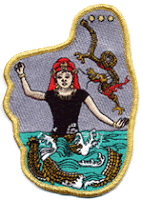 In Isshinryu, as with other martial labeled systems, sometimes oversteps its intent simply because one cannot "prove" the validity of such statements that I am providing in the following post. In my efforts to provide a more accurate, to me and my view that is, picture of the system I would say about the following:
"Isshinryu stresses proficiency with both hand and foot techniques, making it he most versatile form of Karate because you have no weak points."
[In some factions/circles they also profess that the system has an equal number of both hand and foot technique in kata which is not accurate. Do your own count if you practice the system or just call up a kata on Youtube and do a count. In all likelihood you will find a lot more hand stuff then kicks, etc. unless you wish to hide this fact under the guise that the other foot waza are secret/hidden bunkai ;-). I would also ask how anyone can say that Isshinryu is the most "versatile form of karate" with out some sort of research done by an authoritative and scientifically driven organization. Don't folks tend to scream when banks, retailers, and so forth fail to provide the truth in their advertisements but when karate dojo put it out we assume its accuracy and don't question its validity?]
"Isshinryu is the most realistic style of Karate, stressing close-in techniques necessary for "street fighting" where you haven't time for elaborate time consuming wind-ups of other styles."
[The "most realistic style of karate?" Really, who says so and who says they are the ultimate authority. I might have said that I believe it to be the most realistic to my practice but then again I am not trying to irk out a living by the volume of members, etc. Who says Isshinryu is for street-fighting? I can say that it has that potential depending on intent of instruction as long as the person instructing has adequate credentials and experience in violence, etc. I can say most of Isshinryu is for sport, not street.]
"Isshinryu is the most sensible form of Karate, ... "
[Sensible to whom? In my view all systems are good, they all serve a purpose. If you practice Isshinryu most likely you chose it because it or the Sensei fit some perceived need or notion that fit your comfort zone, body style, personality, etc. I can say that I believe most folks regardless of the system of practice can say that theirs is the most sensible, for them.]
"Isshinryu is more adaptable to the American physique and temperament than other more rigid styles because the Okinawa, masters designed it to follow natural body movements."
[Yet, all systems of karate and/or other martial systems are practiced by Americans. Is this saying they had a more difficult time learning their systems than those who learned Isshinryu because their systems are NOT adaptable to American physiques and temperaments? Poppykosh, all systems are good and they all serve a purpose. If it does not follow natural body movements then they require a contortionist to do them. There are adjustments in all physical activities regardless so once again in my opinion, poppykosh!]
"Isshinryu will put you into better physical shape because it " provides you with an aggressive exercise program that will, improve your muscle tone, flexibility, speed, and wind."
[Ok, I can buy this a bit simply because most every dojo, Isshinryu or otherwise, do lots and lots of strenuous activity as warm up and basics. All physical activities that require us to get up off the couch and move are beneficial and will contribute to health and fitness. In my humble opinion it is NOT an aggressive exercise program, it is a budo or fighting or combative system originally but I guess now that it is a sport system it is different.]
In closing, I feel personally it is important to do our best to remain true to the spirit of karate-do, to Tatsuo Sensei's intent for Isshinryu, and to the culture and customs the Okinawan's developed through out their long history. Truth in how we "see," "speak," "act," and "instruct" or system is an important consideration. I try to look at what I broadcast so I can try to pass along accurate stuff. I often ask that if errors or omissions are discovered to provide corrective and constructive feedback/comments and I will make a change.
Some of these quotes are meant to be conveyed as the unique traits of the Isshinryu system and since I have found those traits to be less than accurate I can only say the only "original defining characteristics unique to Isshinryu" at its naming are the vertical fist, the thumb on top of the vertical fist, and the muscle forearm block. I would add that this is important that these particular features/traits, etc. were applicable in the late fifties but today are not exclusive to Isshinryu anymore because many have adopted this stuff.
Think of it this way, just because you say it; just because no one can disprove it; just because no one can connect it to some rule, law, or government requirement does not mean you should use it, say it, write it, or advertise it. It may attract the uninitiated; it may sound cool; it may look cool with graphics YET should you use it?
Ok, someone said, "It isn't going to hurt anyone and it is only a small little white lie anyway." NOT, if you say you are the ultimate course in self defense; you learn my system and can defend anyone against anything. Then your former student gets into a physical altercation, gets hurt, hurts their attacker, etc. gets arrested, gets sued, and so on don't you think a good attorney/lawyer is going to use this to help defend their clients actions and when done in criminal court the others family is going to sue you in civil court? Yes? No? Maybe?
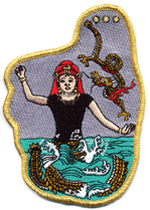
"Isshinryu stresses proficiency with both hand and foot techniques, making it he most versatile form of Karate because you have no weak points."
[In some factions/circles they also profess that the system has an equal number of both hand and foot technique in kata which is not accurate. Do your own count if you practice the system or just call up a kata on Youtube and do a count. In all likelihood you will find a lot more hand stuff then kicks, etc. unless you wish to hide this fact under the guise that the other foot waza are secret/hidden bunkai ;-). I would also ask how anyone can say that Isshinryu is the most "versatile form of karate" with out some sort of research done by an authoritative and scientifically driven organization. Don't folks tend to scream when banks, retailers, and so forth fail to provide the truth in their advertisements but when karate dojo put it out we assume its accuracy and don't question its validity?]
"Isshinryu is the most realistic style of Karate, stressing close-in techniques necessary for "street fighting" where you haven't time for elaborate time consuming wind-ups of other styles."
[The "most realistic style of karate?" Really, who says so and who says they are the ultimate authority. I might have said that I believe it to be the most realistic to my practice but then again I am not trying to irk out a living by the volume of members, etc. Who says Isshinryu is for street-fighting? I can say that it has that potential depending on intent of instruction as long as the person instructing has adequate credentials and experience in violence, etc. I can say most of Isshinryu is for sport, not street.]
"Isshinryu is the most sensible form of Karate, ... "
[Sensible to whom? In my view all systems are good, they all serve a purpose. If you practice Isshinryu most likely you chose it because it or the Sensei fit some perceived need or notion that fit your comfort zone, body style, personality, etc. I can say that I believe most folks regardless of the system of practice can say that theirs is the most sensible, for them.]
"Isshinryu is more adaptable to the American physique and temperament than other more rigid styles because the Okinawa, masters designed it to follow natural body movements."
[Yet, all systems of karate and/or other martial systems are practiced by Americans. Is this saying they had a more difficult time learning their systems than those who learned Isshinryu because their systems are NOT adaptable to American physiques and temperaments? Poppykosh, all systems are good and they all serve a purpose. If it does not follow natural body movements then they require a contortionist to do them. There are adjustments in all physical activities regardless so once again in my opinion, poppykosh!]
"Isshinryu will put you into better physical shape because it " provides you with an aggressive exercise program that will, improve your muscle tone, flexibility, speed, and wind."
[Ok, I can buy this a bit simply because most every dojo, Isshinryu or otherwise, do lots and lots of strenuous activity as warm up and basics. All physical activities that require us to get up off the couch and move are beneficial and will contribute to health and fitness. In my humble opinion it is NOT an aggressive exercise program, it is a budo or fighting or combative system originally but I guess now that it is a sport system it is different.]
In closing, I feel personally it is important to do our best to remain true to the spirit of karate-do, to Tatsuo Sensei's intent for Isshinryu, and to the culture and customs the Okinawan's developed through out their long history. Truth in how we "see," "speak," "act," and "instruct" or system is an important consideration. I try to look at what I broadcast so I can try to pass along accurate stuff. I often ask that if errors or omissions are discovered to provide corrective and constructive feedback/comments and I will make a change.
Some of these quotes are meant to be conveyed as the unique traits of the Isshinryu system and since I have found those traits to be less than accurate I can only say the only "original defining characteristics unique to Isshinryu" at its naming are the vertical fist, the thumb on top of the vertical fist, and the muscle forearm block. I would add that this is important that these particular features/traits, etc. were applicable in the late fifties but today are not exclusive to Isshinryu anymore because many have adopted this stuff.
Think of it this way, just because you say it; just because no one can disprove it; just because no one can connect it to some rule, law, or government requirement does not mean you should use it, say it, write it, or advertise it. It may attract the uninitiated; it may sound cool; it may look cool with graphics YET should you use it?
Ok, someone said, "It isn't going to hurt anyone and it is only a small little white lie anyway." NOT, if you say you are the ultimate course in self defense; you learn my system and can defend anyone against anything. Then your former student gets into a physical altercation, gets hurt, hurts their attacker, etc. gets arrested, gets sued, and so on don't you think a good attorney/lawyer is going to use this to help defend their clients actions and when done in criminal court the others family is going to sue you in civil court? Yes? No? Maybe?
Why study the Chinese ancient classics?
We practice Okinawan Karate, yes? So, a good question is why would we want to study the ancient Chinese classics? In a nutshell to understand the customs of the Okinawans and especially the fighting arts of karate we would want to study the classics because Okinawan's are a product of the Chinese influences and they also studied the classics, the customs, the courtesies, etc. of the Chinese.
The Chinese as to historical data received the greatest influences from them and worked diligently to assume and practice them in a unique Okinawan fashion.
With out going into more depth I would express my answer here through my study of Isshinryu karate-do. Isshinryu is a fairly young Okinawan system but the creator, Tatsuo Shimabuku Sensei, did study the classics such as the Chinese I Ching and Bubushi, which is a tome on Chinese boxing.
He also presented early practitioners a copy of the ken-po goku-i on silk in kanji/English. The significance here is it is derived from his studies and influences from earlier masters of Okinawan karate who also derived these from the study of Chinese classics with an emphasis on the Chinese version of the bubishi.
Do you have to study them to practice/learn/instruct karate in any of its forms? No, you do not yet I firmly believe to achieve greater depth and breadth and understanding and applications you should study them. I firmly believe they are the Yin side of that coin, yang being the physical practice of karate. It will provide guidance and balance in your studies and practices where they will become most influential when you actually take up the instruction of karate-do.
Something one who studies a martial system should consider. You might want to remember that even the Japanese studied the classics and then incorporated what the felt was pertinent into their customs, etc. Everything Japanese/Okinawan were influenced by Chinese connections.
The Chinese as to historical data received the greatest influences from them and worked diligently to assume and practice them in a unique Okinawan fashion.
With out going into more depth I would express my answer here through my study of Isshinryu karate-do. Isshinryu is a fairly young Okinawan system but the creator, Tatsuo Shimabuku Sensei, did study the classics such as the Chinese I Ching and Bubushi, which is a tome on Chinese boxing.
He also presented early practitioners a copy of the ken-po goku-i on silk in kanji/English. The significance here is it is derived from his studies and influences from earlier masters of Okinawan karate who also derived these from the study of Chinese classics with an emphasis on the Chinese version of the bubishi.
Do you have to study them to practice/learn/instruct karate in any of its forms? No, you do not yet I firmly believe to achieve greater depth and breadth and understanding and applications you should study them. I firmly believe they are the Yin side of that coin, yang being the physical practice of karate. It will provide guidance and balance in your studies and practices where they will become most influential when you actually take up the instruction of karate-do.
Something one who studies a martial system should consider. You might want to remember that even the Japanese studied the classics and then incorporated what the felt was pertinent into their customs, etc. Everything Japanese/Okinawan were influenced by Chinese connections.
On Training and Practice
The information processing that the brain must perform to initiate a voluntary movement can be divided into three steps. The first step is to select an appropriate response to the current situation, out of a repertoire of possible responses. This response, which corresponds to a particular behavioral objective, is determined in a global, symbolic fashion.
The second step is to plan the movement in physical terms. This step consists in defining the characteristics of the selected response as the sequence of muscle contractions required to carry it out.
The third step is to actually execute the movement. It is in this step that the motor neurons are activated that trigger the observable mechanics of the movement.
In light of what we now know about the sequence in which the motor areas of the cortex are activated, we can deconstruct the classic sequence "Ready? Set. Go!" in terms of localized activity in the brain.
In the "Ready?" phase, the parietal and frontal lobes become active first, with a contribution from the subcortical structures involved in vigilance and attentiveness.
The "Set" command then activates the supplementary and premotor cortical areas, where the strategies for movement are developed and maintained until the "Go!" signal is given.
The "Go!" signal may come from an outside source, as it does in an actual race [fight?], or it may come from inside the person doing the running [fighting], who decides for himself or herself that all the conditions are present to start running [fighting-defending-protecting].
The "Go!" command then applies information from subcortical structures such as the basal ganglia that will influence Area 6, and then eventually the primary cortex, which will cause the action to be carried out.
In a nutshell this is the process the brain uses, naturally and according to DNA and mother nature, to achieve "correct" application of the "correct" response to stimuli. Upon reviewing this and other data on how the brain works pulling actions in response to stimuli, what actions are pulled, why they are pulled and how we get those that are appropriate to actually go to accomplish a task. In our case, karate, the right moves to not get hit.
As I study this and associate it, encode it, with other studies to include study/practice of karate I can see why repetitive training along with as realistic practice that can be done is imperative to encoding things that will work over the flight-n-fight response which for most folks is freeze or freeze-n-run responses.
Another notable training maxim is to train as close to natural physical responses as you can. If you are a neophyte you may instinctively raise your hands in front of you when some fear inducing stimuli is encountered, i.e. seeing an object coming swiftly toward your face. If you train to raise your hands instinctively and then encode/add a simplistic technique to it then it will be more likely to actually work.
What is described above is pretty much set in the mind and to either enhance natural movement with more effective movement or change it a bit to fit your system takes hard sweat equity work over time, diligent time, and continuous diligent practice time.
http://thebrain.mcgill.ca/flash/index_i.html
The second step is to plan the movement in physical terms. This step consists in defining the characteristics of the selected response as the sequence of muscle contractions required to carry it out.
The third step is to actually execute the movement. It is in this step that the motor neurons are activated that trigger the observable mechanics of the movement.
In light of what we now know about the sequence in which the motor areas of the cortex are activated, we can deconstruct the classic sequence "Ready? Set. Go!" in terms of localized activity in the brain.
In the "Ready?" phase, the parietal and frontal lobes become active first, with a contribution from the subcortical structures involved in vigilance and attentiveness.
The "Set" command then activates the supplementary and premotor cortical areas, where the strategies for movement are developed and maintained until the "Go!" signal is given.
The "Go!" signal may come from an outside source, as it does in an actual race [fight?], or it may come from inside the person doing the running [fighting], who decides for himself or herself that all the conditions are present to start running [fighting-defending-protecting].
The "Go!" command then applies information from subcortical structures such as the basal ganglia that will influence Area 6, and then eventually the primary cortex, which will cause the action to be carried out.
In a nutshell this is the process the brain uses, naturally and according to DNA and mother nature, to achieve "correct" application of the "correct" response to stimuli. Upon reviewing this and other data on how the brain works pulling actions in response to stimuli, what actions are pulled, why they are pulled and how we get those that are appropriate to actually go to accomplish a task. In our case, karate, the right moves to not get hit.
As I study this and associate it, encode it, with other studies to include study/practice of karate I can see why repetitive training along with as realistic practice that can be done is imperative to encoding things that will work over the flight-n-fight response which for most folks is freeze or freeze-n-run responses.
Another notable training maxim is to train as close to natural physical responses as you can. If you are a neophyte you may instinctively raise your hands in front of you when some fear inducing stimuli is encountered, i.e. seeing an object coming swiftly toward your face. If you train to raise your hands instinctively and then encode/add a simplistic technique to it then it will be more likely to actually work.
What is described above is pretty much set in the mind and to either enhance natural movement with more effective movement or change it a bit to fit your system takes hard sweat equity work over time, diligent time, and continuous diligent practice time.
http://thebrain.mcgill.ca/flash/index_i.html
Training vs. Reality: Training for Reality
Training is not reality but reality can be and is training. I say training is not reality because intent although to take you as close as you can is not real life violent encounters. The mindset alone negates this because no matter how close you get training to reality the mind still knows subconsciously and consciously that this is not real.
The reverse can affect someone who actually has to deal with violence on the street, the mind tends to tell someone who has no experience that this is not real, it cannot be happening to me and can cause us to "freeze." So I can extrapolate as to my theories on this area.
There are training scenario's that can at least push a person into a fear factor with adrenaline dumps, etc. After all, fear can be induced either by some danger or some perceived danger. The mind does this to us as a part of our survival instincts from thousands of years in the survival game.
Our minds piece meal data together quickly and that sometimes fools us until the brain can analyze it a bit more ergo why somethings tend to get our emotions going only to find out a minute later we were mistaken. Normal stuff, everyday stuff.
The idea like most training, i.e. military, is to induce stimuli that can and does take you as close to reality as possible with out actually endangering life and limb. Injuries, of course, expected but not a cause of either life endangerment or possible crippling effects, hopefully.
If you do a bit more review on the material I provided on the brain and the various functions you can see between the lines on possible tools to help you and your mind to achieve the ability to turn it on when encountered. It is like Rory Miller's permission to "go" or to "go for it" so a person does not restrict thier actions when needed.
All this is fine and dandy but then again no matter what you do and how close to reality your training is you will never truly know if it works until the first time you have to trigger permission to "go" and to "act" instantly or as close to instantly as humanly possible. That is the crucial point from my perspective, will your mind and your instincts as mother nature provided allow you to "go" to "act" when the rubber hits the road.
Of course, this discussion has, is and will always be there. Last remark, remember just because it might not work one time does not mean it will not work the next time. Sometimes it happens where nothing works then it suddenly works the next time. Self-analysis will help discover the reality of why it did or did not; be brutally honest with yourself. I believe that is why Mr. Miller likes to use in seminars the "AAR's" or after action reports so the group can analyze actions and discover flaws, etc.
Yes? No? Maybe?
Caveat: Remember I am not an expert, I no longer work in a job that requires this (Marines), and I no longer feel I am proficient enough in self defense so take it in, analyze it, see if it works for you and finally validate it from those professionals who do this daily.
The reverse can affect someone who actually has to deal with violence on the street, the mind tends to tell someone who has no experience that this is not real, it cannot be happening to me and can cause us to "freeze." So I can extrapolate as to my theories on this area.
There are training scenario's that can at least push a person into a fear factor with adrenaline dumps, etc. After all, fear can be induced either by some danger or some perceived danger. The mind does this to us as a part of our survival instincts from thousands of years in the survival game.
Our minds piece meal data together quickly and that sometimes fools us until the brain can analyze it a bit more ergo why somethings tend to get our emotions going only to find out a minute later we were mistaken. Normal stuff, everyday stuff.
The idea like most training, i.e. military, is to induce stimuli that can and does take you as close to reality as possible with out actually endangering life and limb. Injuries, of course, expected but not a cause of either life endangerment or possible crippling effects, hopefully.
If you do a bit more review on the material I provided on the brain and the various functions you can see between the lines on possible tools to help you and your mind to achieve the ability to turn it on when encountered. It is like Rory Miller's permission to "go" or to "go for it" so a person does not restrict thier actions when needed.
All this is fine and dandy but then again no matter what you do and how close to reality your training is you will never truly know if it works until the first time you have to trigger permission to "go" and to "act" instantly or as close to instantly as humanly possible. That is the crucial point from my perspective, will your mind and your instincts as mother nature provided allow you to "go" to "act" when the rubber hits the road.
Of course, this discussion has, is and will always be there. Last remark, remember just because it might not work one time does not mean it will not work the next time. Sometimes it happens where nothing works then it suddenly works the next time. Self-analysis will help discover the reality of why it did or did not; be brutally honest with yourself. I believe that is why Mr. Miller likes to use in seminars the "AAR's" or after action reports so the group can analyze actions and discover flaws, etc.
Yes? No? Maybe?
Caveat: Remember I am not an expert, I no longer work in a job that requires this (Marines), and I no longer feel I am proficient enough in self defense so take it in, analyze it, see if it works for you and finally validate it from those professionals who do this daily.
Kata or Embusen or Kata
I can only answer this in a theoretical setting. The reason is there is "no data or historical documents/documentation" to provide us an answer. It is a very good question tho and I am going to answer it only from my personal views and knowledge, as minimalistic as that is.
The kata came first. My belief is that those who came before, the creators of karate as derived from the original indigenous practice of toudi or ti, pulled together their techniques and along with their studies of the Chinese arts of the fist, Chinese boxing, they created their kata.
Lets take it back a bit and try to understand how karate came to be. Okinawa had some form of fighting system which came to be known as "Ti" which is Okinawan dialect for Te or hand if you will. It is also believed that it was referred to as "toudi" or a type of wrestling/grappling/striking system [this is arguable/debatable of course].
The Okinawan's relied heavily on trade with other countries for their livelihood. Their primary sources and influences were Chinese. The trade and exchange with the Chinese is well documented in the only English history book we have and other information/documentation is simply hypothesis by Americans, etc.
The Chinese influences permeated all aspects of life on Okinawa barring the one trait that seems to be exclusive to them, their gentlemanly nature; their peaceful way of politeness and decorum they expressed to anyone and everyone be they friends or conquerors.
The Chinese influences were very strong regarding Okinawan fighting systems in that Chinese boxing was a part of the relations both countries enjoyed for many, many years. We hear stories of Okinawan's traveling to China to learn Chinese boxing which we call "kung fu."
The Chinese already had patterns for practice which we call kata so that in all likelihood influenced Okinawan masters of their systems to incorporate these patterns of fighting into a "kata." We may have found if it were actually documented that they were not called "kata" then but some other Uchinaguchi term, i.e. this is the Okinawan dialect of language.
The Chinese had a name they called the forms or rather the movements, i.e. "Eighteen Movements of Lohan (Order 26). These techniques are thought to be the basis of the modern martial arts and the true origin of Shaolin Kung Fu," as stated here, " http://blog.gronski.org/2010/12/origins-of-shaolin-kung-fu-history-of-the-various-forms/ "
So, regarding karate of Okinawa, the kata came first and the patterns of movements where embusen are formed by the practice came to be and who knows when those lines or blueprints of kata came to be called embusen. I can extrapolate that it might have come from Japanese influences but suspect it actually came from the implementation of the "sportive aspects" and the "implementation to school systems" effort.
Most who refer to embusen tend to connect it to the tournament efforts for start/stop and evaluation grading in competitions.
So, what do you feel is the source and purpose of embusen? The one caveat I would express here and all the time is all information must be taken as theory simply because very little was actually documented for historical purposes.
I my humble opinion documentation of any kind concerning karate did not come to fruition until the late 1800's but more in the 1900's after WWII.
The kata came first. My belief is that those who came before, the creators of karate as derived from the original indigenous practice of toudi or ti, pulled together their techniques and along with their studies of the Chinese arts of the fist, Chinese boxing, they created their kata.
Lets take it back a bit and try to understand how karate came to be. Okinawa had some form of fighting system which came to be known as "Ti" which is Okinawan dialect for Te or hand if you will. It is also believed that it was referred to as "toudi" or a type of wrestling/grappling/striking system [this is arguable/debatable of course].
The Okinawan's relied heavily on trade with other countries for their livelihood. Their primary sources and influences were Chinese. The trade and exchange with the Chinese is well documented in the only English history book we have and other information/documentation is simply hypothesis by Americans, etc.
The Chinese influences permeated all aspects of life on Okinawa barring the one trait that seems to be exclusive to them, their gentlemanly nature; their peaceful way of politeness and decorum they expressed to anyone and everyone be they friends or conquerors.
The Chinese influences were very strong regarding Okinawan fighting systems in that Chinese boxing was a part of the relations both countries enjoyed for many, many years. We hear stories of Okinawan's traveling to China to learn Chinese boxing which we call "kung fu."
The Chinese already had patterns for practice which we call kata so that in all likelihood influenced Okinawan masters of their systems to incorporate these patterns of fighting into a "kata." We may have found if it were actually documented that they were not called "kata" then but some other Uchinaguchi term, i.e. this is the Okinawan dialect of language.
The Chinese had a name they called the forms or rather the movements, i.e. "Eighteen Movements of Lohan (Order 26). These techniques are thought to be the basis of the modern martial arts and the true origin of Shaolin Kung Fu," as stated here, " http://blog.gronski.org/2010/12/origins-of-shaolin-kung-fu-history-of-the-various-forms/ "
So, regarding karate of Okinawa, the kata came first and the patterns of movements where embusen are formed by the practice came to be and who knows when those lines or blueprints of kata came to be called embusen. I can extrapolate that it might have come from Japanese influences but suspect it actually came from the implementation of the "sportive aspects" and the "implementation to school systems" effort.
Most who refer to embusen tend to connect it to the tournament efforts for start/stop and evaluation grading in competitions.
So, what do you feel is the source and purpose of embusen? The one caveat I would express here and all the time is all information must be taken as theory simply because very little was actually documented for historical purposes.
I my humble opinion documentation of any kind concerning karate did not come to fruition until the late 1800's but more in the 1900's after WWII.
Purpose of the Embusen Line
It is another tool to teach the fundamentals of the system. I would suggest that it is a tool that promotes memory lock, i.e. when you associate something with something else that relates to where it reinforces then the memory becomes stronger and easier to reconstruct.
Embusen is that line that also provides guidance as to proper stance to the technique associated with it. Each technique has a specific stance, posture, pose, etc. that maximizes that techniques application. When you follow embusen it provides a means to indicate if a stance is properly assumed or not which affects the applied technique. A blueprint if you will.
It also provides you a means to orient the body to the proper directions, stances, postures, and application of techniques for range, targeting, etc. If you are not orienting your body and direction properly it will show in the initial stages by a loss of proper embusen. You can say it teaches using movement and kamae to cover distance and to gain proper distance to target for the particular technique in the kata.
Once a person learns the fundamentals of the entire kata and set of kata then is the embusen still as important? Less so as the practitioner progresses there is going to be changes and adjustments to suit that particular individual due to many factors such as size, weight, leg length, arm length, etc. which affect momentum, distancing, focus, range to target, etc.
Embusen is the signature of the base gross movement of kata and can be tightened as progress is made until its need and purpose no longer exists. This can happen quickly or in years depending once again on the individual.
Yes? No? Maybe?
Once you achieve proficiency you have to remember strict adherence to embusen means you lose the ability to adjust both stance and technique as it relates to the present moment stimuli. Remember in real fighting you are going to adjust many things according to space, environment, surrounding stuff such as rocks, uneven ground, parked cars, and other obstructions to include the difference between a bit of distance that separates to close up body contact fighting.
You need to adhere to learn but have to adapt when required by the current present moment situation, etc.
I remember watching a practitioner working on Chinto-no-te but kept ending up facing the wrong way and applying a technique ineffectually. I kept an eye on the practice/struggle and it then dawned on me, they are not working or using the embusen; they were not taught what it is and how to use it, etc.
Notes:
- It was argued that embusen plays no role in applications. [not exactly accurate: embusen does play a role for it provides a way to "see" how a kata moves, transitioning between kamae, proper stance to application of waza, etc. Ergo it does play a role but not what most think.]
- It was also argued that it has no significance to kata bunkai. [not exactly accurate: In its usage as a tool to the kata as explained fundamentally it does provide guidance in applying bunkai correctly and efficiently.]
- It was also argued it applied to the teaching of body movement. [Hm, yes and no depending on what you mean by body movement. As to changing and transitioning so that your body mass remains directly behind the direction you move in relation to the application of a technique to create momentum along with range and targeting and such things as focus of application to the vertical axis then it works as it should. It provides a basic/fundamental view or blueprint in learning, practicing and applying various techniques with a caveat that this is a fundamental learning system that will be less stringent as one progresses.]
- Embusen is a tool or strategy for instruction in kata, etc. but also a tool as described above in applying karate to various scenario's in preparation for street protection, combative applications, and fence.
Caveat: one must know how to measure the embusen line to accomplish all the goals of its intent. I would bet that most if not all including Okinawan Masters do not have the dimensions of the line for each kata. It still serves a purpose to orientation, etc. but as to exact stance positions and distance moving in any direction, etc. having the ability to actually create the embusen, for each individual according to height, etc., is difficult or impossible. I suspect it all got lost because it was not transmitted to most, if not all, American Service Persons due to a variety of reasons. Can you recreate it? Possibly.
Note: One statement I read on embusen as to Isshinryu, "To make it work, remember that all steps in kata are adjustable." This made me stop and think to myself, this is backwards sorta. In my view steps should not be adjusted to fit embusen to make it work because returning to the exact start point at the end is achieved by setting proper stances in relation to the techniques and those other factors that make technique effective and powerful. The embusen should work regardless of the person's leg length, their height, and other body factors that differ from person to person. It is a good idea that a part of kata training is to learn the embusen pattern of the kata and then work out the measurements necessary to achieve a proper stance to waza, etc. In my view this is how we associate things to achieve a solid memory and encoding of kata, kata waza, and how it all applies to varying stimuli in combative situations.
Note: I quote another reading, "All things being equal, the person closest to the start of his kata will win in a kata contest." This is of course secondary simply because this involves competitive forms of a tournament. To me this is applying embusen to achieve a pretty form that impresses judges for trophies. The real value in this is the effects felt when competing as they simulate some of the effects one feels to fear, anxiety, etc. in other situations. There is good and not so good in all things, i.e. all bottles are good, they all serve a purpose!
Note: Another quote I wanted to express "my very personal view on," is, "It is important to stay in your embusen in a dojo other wise you run into another practioner." I am not actually disputing this or the other quotes but today this may or may not actually apply and in the end it should not be a focus of great concern as it is not to me a primary goal of this tool of practice and training. To me embusen in relation to others during practice in a small space tends to overshadow the true instruction which is to remain mindful and aware of your surroundings and while performing/practicing kata your awareness, not embusen, should alert you when you are coming into another's space, i.e. a collision is immanent with another, etc.
Note: I would wholeheartedly agree that embusen's start/stop point in most cases being the "one" point is important to both proper execution of kata but more so as to its relation to Yin-n-Yang, i.e. the ken-po goku-i and its connections to the teachings of the Chinese ancient classics.
Note: It was posed once, by another and by me in a post of mine, that embusen actually spell or represent something like a kanji character. I suspect, but cannot prove, this is another American creation. When looking for reasons to express as to why one practices or even learns about something like embusen it is sometimes patched or filled in on the fly to create a more alluring reason why one would bother learning about, researching on, etc. a particular subject or practice such as embusen. My view, in does not matter as long as you and your readers know it is a theory or hypothesis so all who read of it can be inspired to go find answers and learn more.
Question: Which came first, kata or embusen? Good question, so look for my theory/hypothesis in a blog post. :-)
Embusen is that line that also provides guidance as to proper stance to the technique associated with it. Each technique has a specific stance, posture, pose, etc. that maximizes that techniques application. When you follow embusen it provides a means to indicate if a stance is properly assumed or not which affects the applied technique. A blueprint if you will.
It also provides you a means to orient the body to the proper directions, stances, postures, and application of techniques for range, targeting, etc. If you are not orienting your body and direction properly it will show in the initial stages by a loss of proper embusen. You can say it teaches using movement and kamae to cover distance and to gain proper distance to target for the particular technique in the kata.
Once a person learns the fundamentals of the entire kata and set of kata then is the embusen still as important? Less so as the practitioner progresses there is going to be changes and adjustments to suit that particular individual due to many factors such as size, weight, leg length, arm length, etc. which affect momentum, distancing, focus, range to target, etc.
Embusen is the signature of the base gross movement of kata and can be tightened as progress is made until its need and purpose no longer exists. This can happen quickly or in years depending once again on the individual.
Yes? No? Maybe?
Once you achieve proficiency you have to remember strict adherence to embusen means you lose the ability to adjust both stance and technique as it relates to the present moment stimuli. Remember in real fighting you are going to adjust many things according to space, environment, surrounding stuff such as rocks, uneven ground, parked cars, and other obstructions to include the difference between a bit of distance that separates to close up body contact fighting.
You need to adhere to learn but have to adapt when required by the current present moment situation, etc.
I remember watching a practitioner working on Chinto-no-te but kept ending up facing the wrong way and applying a technique ineffectually. I kept an eye on the practice/struggle and it then dawned on me, they are not working or using the embusen; they were not taught what it is and how to use it, etc.
Notes:
- It was argued that embusen plays no role in applications. [not exactly accurate: embusen does play a role for it provides a way to "see" how a kata moves, transitioning between kamae, proper stance to application of waza, etc. Ergo it does play a role but not what most think.]
- It was also argued that it has no significance to kata bunkai. [not exactly accurate: In its usage as a tool to the kata as explained fundamentally it does provide guidance in applying bunkai correctly and efficiently.]
- It was also argued it applied to the teaching of body movement. [Hm, yes and no depending on what you mean by body movement. As to changing and transitioning so that your body mass remains directly behind the direction you move in relation to the application of a technique to create momentum along with range and targeting and such things as focus of application to the vertical axis then it works as it should. It provides a basic/fundamental view or blueprint in learning, practicing and applying various techniques with a caveat that this is a fundamental learning system that will be less stringent as one progresses.]
- Embusen is a tool or strategy for instruction in kata, etc. but also a tool as described above in applying karate to various scenario's in preparation for street protection, combative applications, and fence.
Caveat: one must know how to measure the embusen line to accomplish all the goals of its intent. I would bet that most if not all including Okinawan Masters do not have the dimensions of the line for each kata. It still serves a purpose to orientation, etc. but as to exact stance positions and distance moving in any direction, etc. having the ability to actually create the embusen, for each individual according to height, etc., is difficult or impossible. I suspect it all got lost because it was not transmitted to most, if not all, American Service Persons due to a variety of reasons. Can you recreate it? Possibly.
Note: One statement I read on embusen as to Isshinryu, "To make it work, remember that all steps in kata are adjustable." This made me stop and think to myself, this is backwards sorta. In my view steps should not be adjusted to fit embusen to make it work because returning to the exact start point at the end is achieved by setting proper stances in relation to the techniques and those other factors that make technique effective and powerful. The embusen should work regardless of the person's leg length, their height, and other body factors that differ from person to person. It is a good idea that a part of kata training is to learn the embusen pattern of the kata and then work out the measurements necessary to achieve a proper stance to waza, etc. In my view this is how we associate things to achieve a solid memory and encoding of kata, kata waza, and how it all applies to varying stimuli in combative situations.
Note: I quote another reading, "All things being equal, the person closest to the start of his kata will win in a kata contest." This is of course secondary simply because this involves competitive forms of a tournament. To me this is applying embusen to achieve a pretty form that impresses judges for trophies. The real value in this is the effects felt when competing as they simulate some of the effects one feels to fear, anxiety, etc. in other situations. There is good and not so good in all things, i.e. all bottles are good, they all serve a purpose!
Note: Another quote I wanted to express "my very personal view on," is, "It is important to stay in your embusen in a dojo other wise you run into another practioner." I am not actually disputing this or the other quotes but today this may or may not actually apply and in the end it should not be a focus of great concern as it is not to me a primary goal of this tool of practice and training. To me embusen in relation to others during practice in a small space tends to overshadow the true instruction which is to remain mindful and aware of your surroundings and while performing/practicing kata your awareness, not embusen, should alert you when you are coming into another's space, i.e. a collision is immanent with another, etc.
Note: I would wholeheartedly agree that embusen's start/stop point in most cases being the "one" point is important to both proper execution of kata but more so as to its relation to Yin-n-Yang, i.e. the ken-po goku-i and its connections to the teachings of the Chinese ancient classics.
Note: It was posed once, by another and by me in a post of mine, that embusen actually spell or represent something like a kanji character. I suspect, but cannot prove, this is another American creation. When looking for reasons to express as to why one practices or even learns about something like embusen it is sometimes patched or filled in on the fly to create a more alluring reason why one would bother learning about, researching on, etc. a particular subject or practice such as embusen. My view, in does not matter as long as you and your readers know it is a theory or hypothesis so all who read of it can be inspired to go find answers and learn more.
Question: Which came first, kata or embusen? Good question, so look for my theory/hypothesis in a blog post. :-)
Lineage?
I may have posted on this before. I read a blog today that spoke of this topic so it kind of spurred me to give my "opinion." I still don't really understand why folks tend to speak of linage as if the closer you are to the founder of a system the greater your teachings and knowledge. It is like, to my mind at this moment, saying because I studied directly under Tatsuo Sensei I have some insight and ability to teach/practice/instruct that others are missing.
This brings to mind the ken-po goku-i silk certificate Tatsuo Sensei provided early practitioners. Today, much like lineage, it seems to denote some special status that I cannot fathom. I would look at the silk certificate literally as a keepsake that has value only to me and to him yet to take it further seems ludicrous because its perceive importance tends to loose steam when you find out the holder has no clue to its purpose, meaning, relation to Tatsuo, and to the spirit/custom/beliefs of the founder even if that is important.
Maybe I feel this way and spout of like this because I can't say that I studied directly under Tatsuo Sensei, etc. Maybe it has something to do with "family connections" such as family history and lineage. Knowing one's history can tell that person a lot and even provide them some means of knowledge that helps them in their current life yet in reality it means something of significance ONLY to that person, no one else. It does not provide some special status either, just a way to learn of our customs, history, family, and past. We can and do learn from our past YET once again it does not indicate some special status in society.
In reality, what you currently know and practice is of greater importance. It is meaningful to you, the practitioner, and your Sensei, no one else. Just because your Sensei studied under so-n-so and his so-n-so under another back to the founder. I can say emphatically that I have witnessed at least one person who studied under Tatsuo Sensei directly, sorta, that because they lack the ability to "teach/instruct" and they are missing the "basics-fundamentals" that what they passed on is not really what Tatsuo Sensei passed to his so called first generation American students.
Then again cause I can't lay claim to a special lineage it could mean I am just jealous. But, then again, it is my blog and my opinion and if your not agreeing then either leave or comment or just do nothing and disagree or agree as you wish ... cool!
Oh, you want my lineage? Ok, Warner Dean Henry, retired Marine Sergeant Major who studied martial arts since the mid to late fifties. He introduced me to Isshinryu and I have never looked back since. I once asked if he studied under Tatsuo Sense and only years later did he tell me, "The ole man always sat on the side drinking tea while I worked out with senior Marines." Ok, cool, now I are special too, yes? ;-)
This brings to mind the ken-po goku-i silk certificate Tatsuo Sensei provided early practitioners. Today, much like lineage, it seems to denote some special status that I cannot fathom. I would look at the silk certificate literally as a keepsake that has value only to me and to him yet to take it further seems ludicrous because its perceive importance tends to loose steam when you find out the holder has no clue to its purpose, meaning, relation to Tatsuo, and to the spirit/custom/beliefs of the founder even if that is important.
Maybe I feel this way and spout of like this because I can't say that I studied directly under Tatsuo Sensei, etc. Maybe it has something to do with "family connections" such as family history and lineage. Knowing one's history can tell that person a lot and even provide them some means of knowledge that helps them in their current life yet in reality it means something of significance ONLY to that person, no one else. It does not provide some special status either, just a way to learn of our customs, history, family, and past. We can and do learn from our past YET once again it does not indicate some special status in society.
In reality, what you currently know and practice is of greater importance. It is meaningful to you, the practitioner, and your Sensei, no one else. Just because your Sensei studied under so-n-so and his so-n-so under another back to the founder. I can say emphatically that I have witnessed at least one person who studied under Tatsuo Sensei directly, sorta, that because they lack the ability to "teach/instruct" and they are missing the "basics-fundamentals" that what they passed on is not really what Tatsuo Sensei passed to his so called first generation American students.
Then again cause I can't lay claim to a special lineage it could mean I am just jealous. But, then again, it is my blog and my opinion and if your not agreeing then either leave or comment or just do nothing and disagree or agree as you wish ... cool!
Oh, you want my lineage? Ok, Warner Dean Henry, retired Marine Sergeant Major who studied martial arts since the mid to late fifties. He introduced me to Isshinryu and I have never looked back since. I once asked if he studied under Tatsuo Sense and only years later did he tell me, "The ole man always sat on the side drinking tea while I worked out with senior Marines." Ok, cool, now I are special too, yes? ;-)
Subscribe to:
Posts (Atom)